
Automated data collection
Automated data collection creates value
✅ Full overview in real-time
✅ Less waste, better operation
✅ Lower energy costs
✅ Simple ESG reporting
✅ Stronger production insights
Why automated and unified data collection creates real value in production
Automated data collection is no longer a “nice to have” – it’s the foundation of modern, competitive manufacturing.
When data from machines, ERP systems, operators and energy consumption is gathered in one place, a kind of insight emerges that none of the systems can deliver alone. It is precisely this insight that PLEET makes available.
Holistic understanding instead of date silos
For many companies, production data is scattered:
- Machines detect operation, stops and output
- ERP system manages orders, materials and planning
- Operators have the practical knowledge of deviations and causes
- Energy consumption is in meters, bills or separate systems
Individually, these data sources only provide a fragmented picture. But when combined automatically and in real-time, they provide a complete overview of what’s actually happening in production – and why.
From raw data to valuable insights
When data flows freely between systems, the business can begin to see patterns, correlations and causes that would otherwise be hidden. It provides the opportunity to:
- Identify bottlenecks and inefficient processes
- Predict problems before they happen
- Optimize planning and capacity utilization
- Improve quality by linking errors and deviations to specific incidents
- Document performance to customers and certification requirements
- Understand energy consumption across machines, lines and times
When energy data is coupled with production data, it becomes possible to see exactly where and when energy is used – and what drives consumption.
This allows for both optimization and savings.
Energy data as the key to ESG reporting
ESG requirements are becoming increasingly complex and many companies spend unnecessary time manually collecting energy data.
With PLEET, energy consumption can be collected automatically, structured and linked directly to production. It provides:
- Documentable and valid ESG data
- Automated basis for CO₂ calculations
- Ability to track energy consumption in real-time
- Insight into energy-intensive processes to reduce consumption and costs
This makes ESG reporting easier, more accurate and far more valuable.
Real-time insights as a competitive advantage
When data is collected automatically and displayed in real-time, managers and operators can react immediately. What it means:
- Less wasted time
- Faster problem solving
- Better coordination between production and planning
- Increased delivery reliability
- Ability to move energy-intensive processes to times of lower load or lower energy prices
Real-time data makes production more agile, energy efficient and robust – and that has a direct impact on the bottom line.
The role of the operator is getting stronger
Automated data collection is not about replacing operator knowledge – quite the opposite. When operator input is combined with machine data, ERP data and energy data, their experiences are documented and translated into concrete improvement knowledge. It creates:
- Better decisions
- More accurate analytics
- A stronger improvement culture
The result: Smarter, more efficient and more sustainable production
By collecting data from the entire value chain – including energy consumption – the company gets a data-driven foundation that enables it to optimize operations, quality, planning and sustainability. It is precisely this cohesion that PLEET delivers
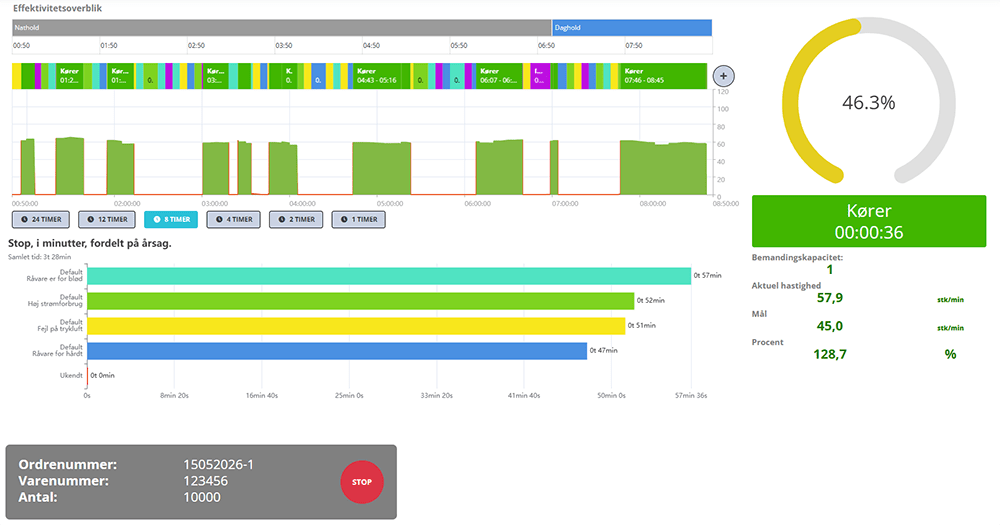
Number of stops grouped and distributed by reason

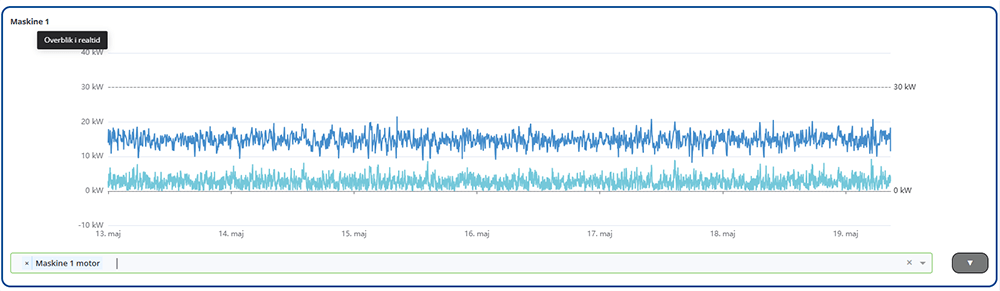
Real-time overview on 1 machine
Efficiency overview
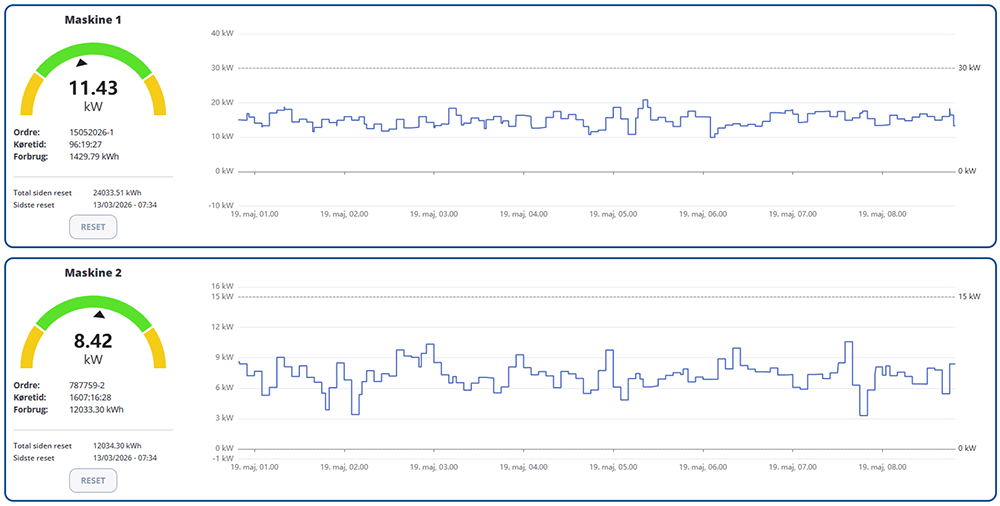
Efficiency overview 2 machines
Do you have any questions? – Contact us today

